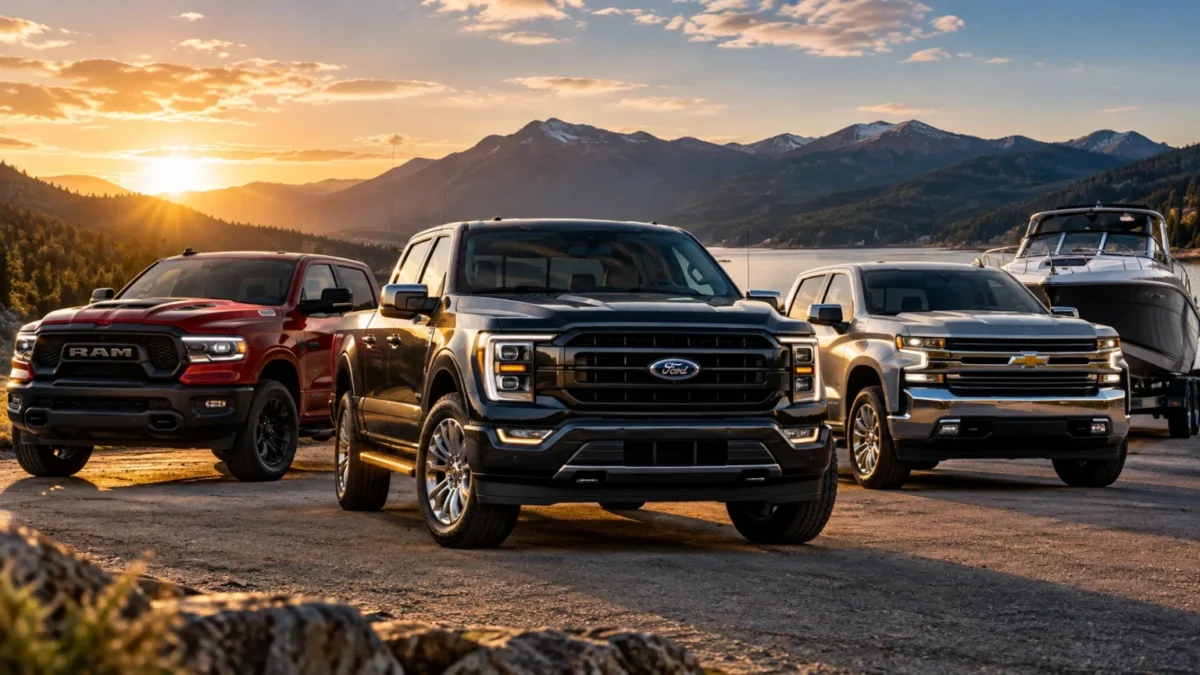
V8-Powered Pickups: Twin-turbocharged engines are becoming increasingly common in full-size pickup trucks, but traditional V8 power is far from finished. For buyers who want a truck that can pull a heavy trailer without relying on a twin-turbo gasoline engine, several American pickups still make a compelling case.
The 2026 Ford F-150, Ram 1500, and Chevrolet Silverado 1500 offer naturally aspirated V8 options that combine strong output with substantial towing capability. Their maximum towing ratings depend on engine choice, drivetrain, axle ratio, cab configuration, and optional towing equipment, but the numbers show that a traditional V8 can still handle serious work.
The Ford F-150 5.0-liter V8 can tow up to 12,800 pounds in certain configurations, while the Ram 1500 with its returning 5.7-liter HEMI V8 is rated for up to 11,320 pounds. Both clear the 11,000-pound mark without using a twin-turbocharged gasoline engine.
Here’s what buyers should know about these trucks, how their engines differ, and why naturally aspirated V8s continue to appeal to American truck owners.
1. 2026 Ford F-150: The 5.0-Liter V8 Still Has Plenty of Muscle
The Ford F-150 remains one of the most recognizable full-size pickups in America, and its available 5.0-liter Coyote V8 gives buyers an alternative to Ford’s turbocharged EcoBoost engines.
The naturally aspirated V8 produces approximately 400 horsepower and 410 lb-ft of torque. Rather than using turbochargers to increase engine output, it relies on its displacement and conventional internal-combustion design.
When properly equipped, the 2026 F-150 with the 5.0-liter V8 can tow up to 12,800 pounds in certain configurations. Buyers should not assume every V8-powered F-150 can achieve that rating, because the maximum depends on the truck’s exact specification.
Ford also offers the F-150 with a 3.5-liter EcoBoost V6, which can achieve a higher maximum towing rating across the model lineup. However, that engine uses twin turbochargers, making the 5.0-liter V8 a relevant choice for buyers specifically seeking naturally aspirated power.
The V8’s appeal goes beyond its towing rating. Some owners prefer its traditional throttle response, familiar exhaust note, and straightforward power delivery. It also gives buyers a way to get a conventional eight-cylinder engine without stepping into a heavy-duty truck.
For someone who regularly tows a large boat, utility trailer, or appropriately sized travel trailer, the F-150 V8 deserves consideration. The key is to select the right configuration instead of shopping by engine name alone.
2. 2026 Ram 1500: The HEMI V8 Returns
Ram’s decision to bring back the 5.7-liter HEMI V8 for the 2026 Ram 1500 gives traditional V8 fans another full-size pickup to consider.
The returning HEMI produces 395 horsepower and 410 lb-ft of torque. Ram lists a maximum towing capacity of 11,320 pounds for the HEMI-powered truck, depending on configuration.
That rating puts the Ram above the 11,000-pound threshold while keeping a naturally aspirated V8 in the engine lineup. It is an important option for buyers who prefer a conventional gasoline V8 over the company’s newer twin-turbocharged inline-six engines.
The HEMI is not the most powerful engine available in the Ram 1500 lineup. Ram’s 3.0-liter Hurricane inline-six is offered in standard-output and high-output versions, with the high-output model producing considerably more horsepower than the V8.
However, maximum horsepower is not the only factor that matters when choosing a truck. Buyers may also consider engine character, expected maintenance needs, purchase price, fuel economy, long-term ownership plans, and how often they tow.
The V8-Powered Pickups also has a reputation for emphasizing ride comfort and interior refinement. That can matter to drivers who use their pickups for daily commuting as well as weekend towing.
The important caveat is that the 11,320-pound figure represents a maximum, not a rating that applies to every HEMI-powered Ram. Before buying, shoppers should check the exact truck’s towing guide and payload information.
3. Chevrolet Silverado 1500: The 6.2-Liter V8 Alternative
The Chevrolet Silverado 1500 continues to offer naturally aspirated V8 engines for buyers who want conventional gasoline power in a full-size pickup.
Its available 6.2-liter EcoTec3 V8 produces up to 420 horsepower and 460 lb-ft of torque. The engine’s larger displacement and output make it an appealing option for drivers who want a powerful V8 for hauling and towing.
The Silverado’s overall maximum towing rating reaches up to 13,300 pounds in certain configurations. However, Chevrolet’s headline maximum is configuration-dependent, and buyers should verify the towing rating specifically associated with the 6.2-liter V8 rather than automatically attributing the lineup’s highest figure to every V8 model.
The Silverado also offers a 5.3-liter V8, providing another naturally aspirated option for buyers who do not necessarily need the larger engine.
Compared with a smaller turbocharged engine, the 6.2-liter V8 offers a different driving character. Its power delivery, exhaust sound, and traditional V8 layout are part of the appeal, particularly for drivers who want their truck to feel like a conventional American pickup.
That does not automatically make it more reliable, cheaper to maintain, or more fuel-efficient than a turbocharged alternative. Those outcomes depend on the vehicle, usage, maintenance history, and driving conditions.
For buyers comparing the Silverado with the F-150 and Ram 1500, the best approach is to compare equivalent configurations and engine-specific tow ratings rather than relying on each truck’s maximum advertised number.
Naturally Aspirated V8 vs. Twin-Turbo Engines: What’s the Difference?
The debate between naturally aspirated V8s and twin-turbocharged engines is about more than the number of cylinders.
A naturally aspirated engine draws air into the cylinders without using an exhaust-driven turbocharger or a mechanically driven supercharger. A turbocharged engine uses exhaust energy to compress incoming air, allowing the engine to produce more power from a given displacement.
That difference affects how an engine delivers power and how its systems are engineered.
Why some truck buyers prefer a naturally aspirated V8
Traditional power delivery: Many drivers enjoy the way a naturally aspirated V8 responds to throttle input, especially when accelerating under load.
Familiar engine character: The sound and feel of a V8 remain important to enthusiasts who want a conventional American pickup experience.
No turbocharger hardware: A naturally aspirated V8 does not require turbochargers and their associated plumbing. However, it still contains complex systems, and the absence of turbochargers does not guarantee lower repair costs or greater reliability.
Strong towing capability: The F-150 5.0-liter V8 and Ram 1500 5.7-liter HEMI demonstrate that naturally aspirated gasoline engines can exceed 11,000 pounds of maximum towing capacity in specific configurations.
Why twin-turbo engines remain competitive
Twin-turbocharged engines can generate substantial torque and horsepower from smaller displacements. That can be useful when pulling heavy loads, accelerating on highway ramps, or climbing grades.
Modern turbocharged engines also use sophisticated engine management systems to balance performance, emissions, and fuel consumption.
There is no universal winner. The right powertrain depends on how the truck will be used, the loads it will tow, the owner’s budget, and personal driving preferences.
Towing Capacity Is About More Than Engine Size
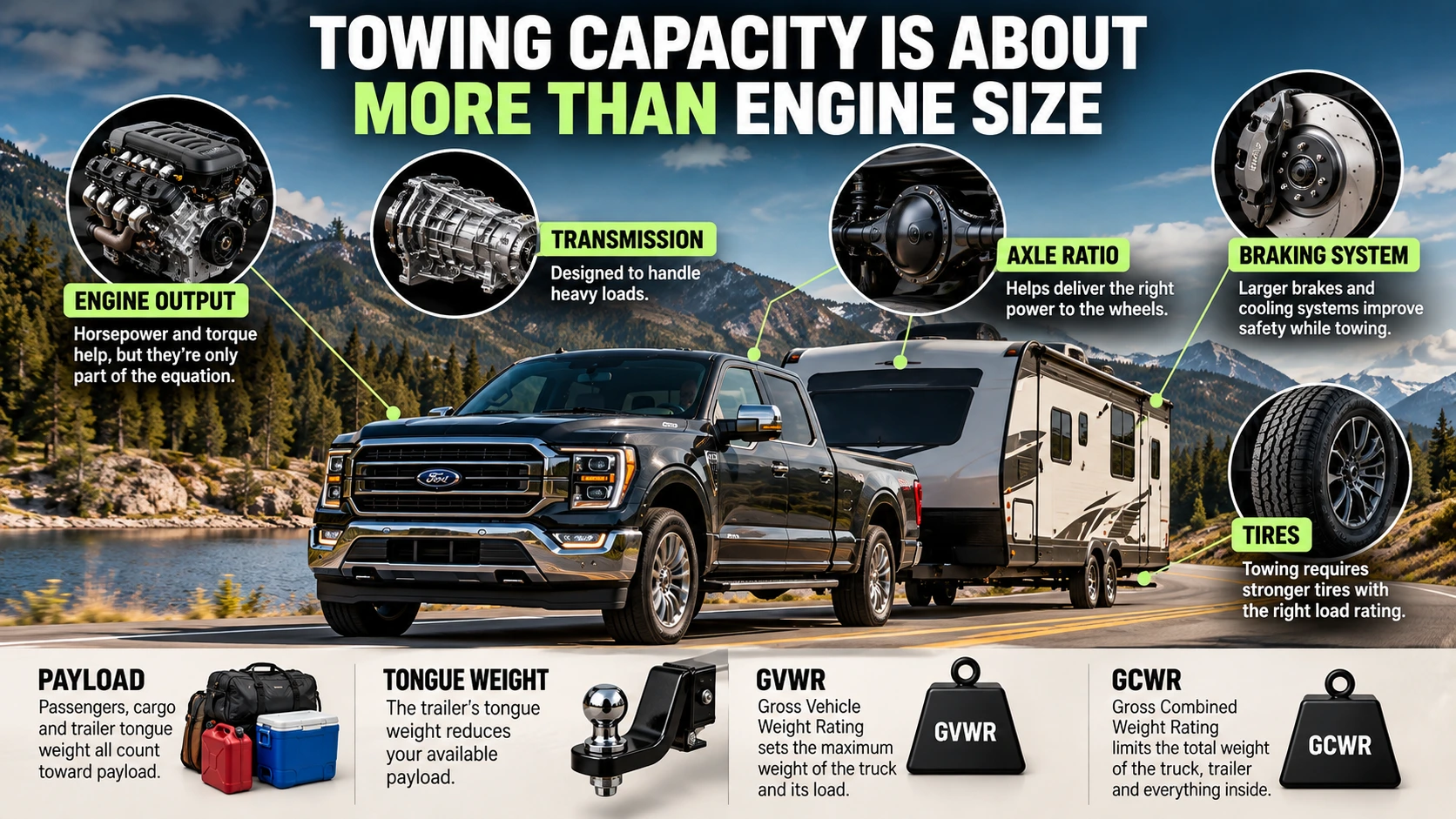
An engine’s horsepower and torque figures are only part of the towing equation. A truck’s chassis, brakes, cooling system, transmission, axle ratio, tires, and overall weight ratings also influence its ability to tow safely.
The advertised maximum towing capacity generally applies to a particular configuration. A different cab, bed, drivetrain, axle ratio, or equipment package can change the rating.
Payload is equally important. Passengers, luggage, cargo, and the trailer’s tongue weight all count toward the truck’s available payload. A pickup may have an impressive maximum towing figure but still run out of payload capacity before reaching that limit with a particular trailer setup.
Buyers should also check the truck’s Gross Vehicle Weight Rating, Gross Combined Weight Rating, and the applicable limits for the hitch and trailer.
Before purchasing a truck for an 11,000-pound trailer, compare the actual trailer weight when loaded for travel with the truck’s published ratings. A suitable safety margin is preferable to operating continuously at the maximum.
Which V8 Pickup Makes the Most Sense?
The Ford F-150 5.0-liter V8 is worth considering for buyers who want a naturally aspirated V8 with a published maximum towing rating above 12,000 pounds in certain configurations.
The Ram 1500 5.7-liter HEMI is an alternative for drivers who want a traditional V8 and a maximum towing rating above 11,000 pounds, along with the Ram’s comfort-oriented character.
The Chevrolet Silverado 1500’s available 6.2-liter V8 is another option for shoppers who prioritize a larger-displacement gasoline V8. Its engine-specific towing capability should be checked against the exact model and equipment.
No single truck is the right choice for every buyer. Someone who tows frequently over long distances may prioritize torque delivery, cooling, and fuel costs. Someone who tows a boat occasionally may put greater value on ride comfort, everyday drivability, or the engine’s character.
The Bottom Line
Twin-turbocharged engines have become important players in the full-size pickup market, but naturally aspirated V8s remain capable alternatives.
The 2026 Ford F-150 5.0-liter V8 can tow up to 12,800 pounds in certain configurations, and the 2026 Ram 1500 5.7-liter HEMI V8 is rated for up to 11,320 pounds. Chevrolet also continues to offer naturally aspirated V8 power in the Silverado 1500 lineup.
For buyers who prefer traditional eight-cylinder engines, these trucks show that turbocharging is not a requirement for crossing the 11,000-pound towing threshold. The smarter buying decision is to verify the exact configuration, payload, and trailer weight before choosing a truck.
Frequently Asked Questions
Can a naturally aspirated V8 tow more than 11,000 pounds?
Yes. The 2026 Ford F-150 with the 5.0-liter V8 is rated for up to 12,800 pounds in certain configurations, while the Ram 1500 with the 5.7-liter HEMI V8 is rated for up to 11,320 pounds.
Does a twin-turbo engine tow better than a V8?
Not automatically. Towing capability depends on the engine and the complete truck configuration, including gearing, cooling, chassis, and equipment.
Which 2026 Ram 1500 engine is the HEMI V8?
The returning 5.7-liter HEMI V8 produces 395 horsepower and 410 lb-ft of torque.
Is the Chevrolet Silverado 1500 available with a naturally aspirated V8?
Yes. The Silverado 1500 offers 5.3-liter and 6.2-liter naturally aspirated V8 engines. Towing ratings vary by engine and configuration.
Should I buy a truck rated to tow exactly what my trailer weighs?
It is better to check all applicable ratings and leave a suitable margin. Account for the trailer’s loaded weight, tongue weight, passengers, cargo, payload, hitch rating, and the truck’s specific towing limits.